
Carney Record Sources by Era
Each era demands a different source. For the present, SDAT anchors the parcel, but it is no household history for Carney. Courthouse land records for Baltimore County begin in 1851. Anything earlier lives with Maryland State Archives series, historical indexes, microfilm, paper books, and some older Baltimore City copies. These bridge quiet years. Directories, census releases, permit files, and estate records help when their place and date match the address.
| Source | Years It Covers | Where Held | What It Shows |
|---|---|---|---|
| SDAT assessment record | Current public assessment data; historic online range not located | Maryland SDAT | Current owner line, mailing and premises addresses, PAN, deed reference, sales, and structure fields. |
| Baltimore County land records | 1851 onward series; exact MDLandRec online cutoff not verified | Circuit Court Clerk, MDLandRec, and Maryland State Archives | Grantor, grantee, instrument, legal description, book/page, and transfer chain. |
| Earlier county records | County series reach back to 1659/1661; image availability varies | Maryland State Archives and older Baltimore City copies | Early deeds, mortgages, leases, and claims, with custody and fire-related gaps. |
| City and suburban directories | City/suburb collections include 1957–59, 1961, and 1963–65; Carney inclusion not confirmed | Maryland State Archives and related repositories | Dated name-and-address leads; each volume's geographic scope must be checked. |
| Federal census | Public releases under the 72-year rule | National sources and BCPL genealogy databases | Household composition and enumeration-district context, not modern CDP geography. |
| Permits, probate, and notices | Current portal or collection coverage varies | Citizen Access, Register of Wills, BCPL, Pratt, and Archives | Work dates, estates, obituaries, and transfer clues that need corroboration. |
Work from the period nearest your question. A recent transfer starts with SDAT and the deed index. When the online record stops, switch repositories. Do not invent an unverified year range for Carney. A directory or newspaper clue belongs between deeds. Probate explains why a later conveyance names an estate or representative.
Freeze a Carney Property Record
Start with the SDAT Real Property Search. Before chasing past residents, record the PAN, legal description, deed reference, lot, and premises address from the parcel card. Save the mailing address separately. The two fields do different jobs. Premises identifies the property itself, while mailing points to assessment correspondence that can sit outside Carney. The SDAT owner line reflects the last deed's indexed ownership, and it may name an estate, trust, or entity.
Then confirm the parcel in the Baltimore County Property MapServer. Note the polygon and its neighbors. Add the road name, subdivision, and plat reference. Same-name transfers cause mix-ups. A similar street can also drag the trail onto the wrong lot in Carney. SDAT is not a survey, and the map is not legal evidence, but together they build a stable key for the deed chain.
Keep the postal city exactly as recorded. Carney parcels may carry Parkville or Nottingham mailing labels, and the 21234/21236 split is address-specific. A postal label proves nothing about municipal status.
Note: Preserve the premises, mailing, and legal-description fields separately, since each one captures a different part of the address history.
Carney's 1851 Land-Record Break
The 1851 boundary is the decisive fact for any Carney deed trail. Courthouse material starts there. Everything earlier must be pursued through Maryland State Archives series, historical indexes, and related copies. The line reflects custody and research paths. It does not mark the region's first land transaction.
Archives history also notes an 1835 courthouse fire. That blaze left gaps in early material, especially in administrative and judgment series. The gap is real. A web search can legitimately end there for a historical reason. The right response is an Archives finding aid, a paper book, microfilm, or searchroom assistance from the clerk. Never fill the gap with a guess.
Note: Record the repository and book or series reference whenever the source changes, because the early Baltimore County trail crosses county, Archives, and older city custody.
Trace Carney Deed Records
Deeds identify transfers, not every occupant. Still, they give the strongest chronological chain of recorded ownership for a Carney property. Start from the current SDAT deed reference. In MDLandRec, choose Baltimore County. Use the book/page route where possible, and if that reference is unavailable, search the current owner as a grantee, comparing the legal description, lot, subdivision, plat, instrument, date, and parties before accepting a match.
- Copy the current parcel's PAN, legal description, lot or subdivision, and SDAT book/page reference. Treat the mailing address as a separate clue.
- Open the purchase deed in Maryland Land Records V5.0. Record the grantor, grantee, instrument type, recording date, and legal-description language.
- Search the seller, who is the grantor in the current deed, as a grantee in an earlier deed. This identifies the seller's prior purchase when the parcel details match.
- Use a prior book/page or a “being the same as” reference when the deed provides one. If it does not, compare the grantor index against the lot, plat, subdivision, and legal description.
- Repeat backward until the web index stops. Then use the clerk, Maryland State Archives historical indexes, microfilm, paper books, or a specific copy request for the next era.
- Grantor and grantee
- The grantor transfers an interest. The grantee receives it. Their roles can reverse in the next deed.
- Chain of title
- A sequence of recorded transfers for the same parcel, checked by parcel details rather than name alone.
- Legal description
- The lot, block, subdivision, plat, or metes-and-bounds language that identifies property more reliably than an older street label.
- Enumeration district
- The census geography recorded on a historical schedule. It may not match today's Carney CDP boundary.
A same-name match proves little on its own.
Note: the parcel description, subdivision, lot, plat, and dates must all point to the same Carney property before you accept the deed.
Carney Land Records V5.0
Maryland Land Records V5.0 launched on November 17, 2025. The system needs an account. Email verification and MFA guard the door, and name search supports documented modifiers including Is, Begins With, Ends With, Contains, Fuzzy, and Soundex. Baltimore County search fields cover county, book/page, party name, party type, instrument, date range, and cross-reference. That power has a limit. A common name stays stubbornly common until parcel facts narrow it for a Carney deed search. The MDLandRec V5.0 sign-in route opens the official gateway. It handles the current index and account workflow.
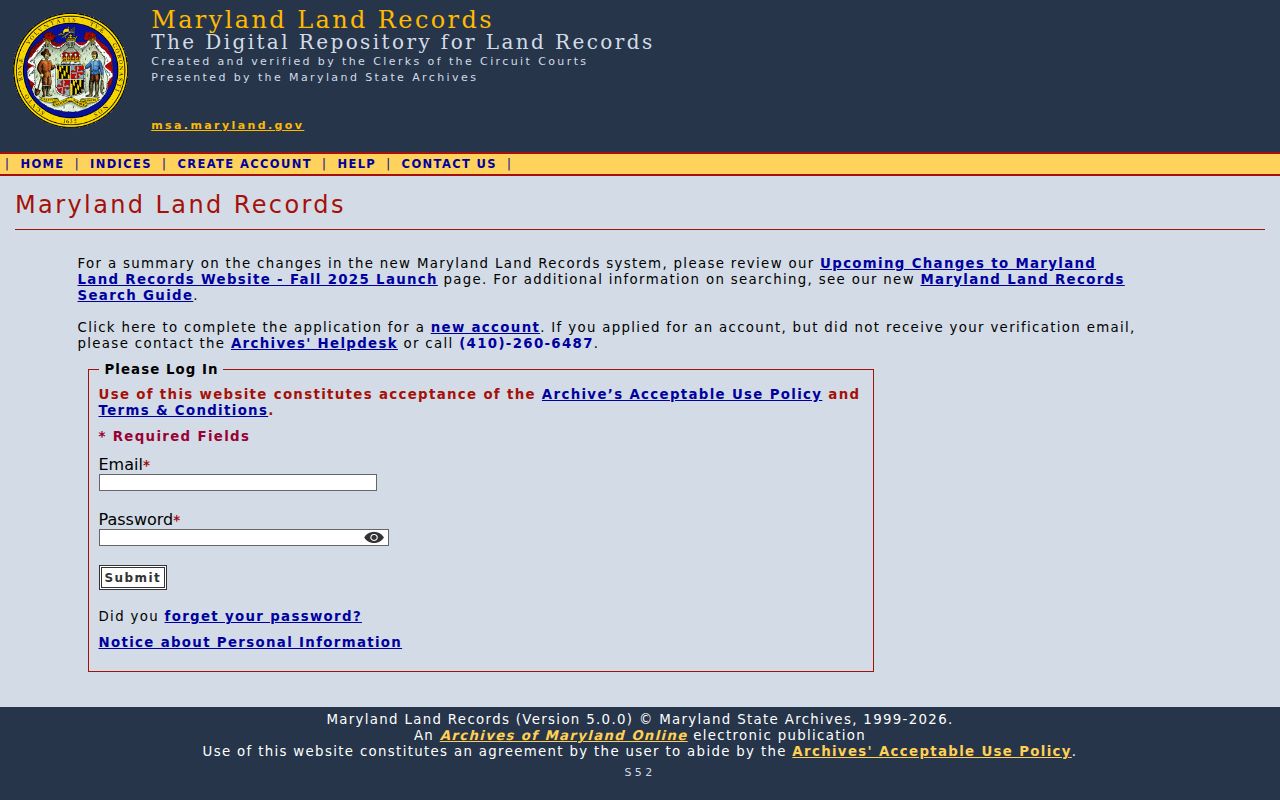
The login view signals a practical fallback. When a historical record, image, or certified copy is not available through the web account, the Circuit Court Clerk or Archives route takes over.
Official sources disagree. Image access and purchase behavior are live questions, so verify the portal or the clerk's copy instructions rather than assigning an unsupported fee. Historic and retired indexes can be inaccurate. A prior reference and the parcel description stay more dependable than a bare name result. Trust the parcel first.
Carney Plats Keep Streets Stable
A plat earns its keep when a deed leans on lot-and-subdivision wording. It also helps when an old address took a different form. It lays out the subdivision, lot, block, easements, rights-of-way, and road pattern in one drawing. Before concluding that two street labels point to different properties, set the plat reference beside the SDAT PAN. Set it beside the legal description too. The plat bridges map geometry and the recorded deed language. That is exactly where a Carney address-history search tends to stall. Maryland keeps its plat images in one place. The Maryland digital plats portal is the state image route for that step.
Check the plat first. Verify the physical and legal parcel relationship next. Only then link an old road reference to a present address. The county publishes no record of a Carney-wide renumbering or a named street-change event, and its addressing rules stay steady: hundred-block continuity, unit blocks for courts, frontage for panhandle lots, and letters for inserted addresses. That stability is the norm here. When a label still mismatches, compare the deed, plat, GIS, USPS standardization, and the historical source instead of assigning an unsourced change year.
Carney Previous Household Records
Deeds name owners, not the households between transfers. A directory, census schedule, newspaper notice, or library file can fill the gap with a dated lead, but no Carney-specific directory run or exact criss-cross years appear in the state's lists. The Maryland State Archives catalogs Baltimore City and city-and-suburbs collections. One suburban group spans 1957–59, 1961, and 1963–65. Scope varies volume to volume. Inspect each before linking it to a Carney address. For guidance, the BCPL “Uncovering History of Your Home” program listing opens the library's local home-history research connection.
An unverified street lead deserves a human check. The Parkville-Carney Branch reference desk can route a question into wider Baltimore County and genealogy resources rather than inventing a local shelf. One record never settles it; the household process is a comparison, not a claim.
- Write down the address spelling, postal city, legal description, and date from the deed or parcel record.
- Check the Maryland State Archives directory guide for a city, suburbs, or suburban volume, and read its own scope and abbreviation key.
- Read the same address in the nearest available years before and after a released census year. An occupation or spouse notation is only a clue.
- Pair that lead with a federal census image and its enumeration district. Compare household composition, age, birthplace, and address context without treating the directory as a census substitute.
- Confirm a move, death, or estate transition with a later deed, notice, probate file, or another dated source.
The Carney city directory page describes the historical collections themselves. For a Carney address, request Baltimore County, Parkville, suburban, telephone, or reverse-directory material by year.
Carney Past Records and Estates
Citizen Access can date a construction, land-management, or code event at an address. Search by street number, street name, street type, ZIP, case number, or date range. The applicant may be an owner, contractor, or entity. Treat the date as a property-history clue, and pull the named public record if the online entry runs thin. For anything unavailable through PAI, file a narrow Maryland Public Information Act request listing the address, parcel or case number, and date range.
A deed chain often ends at a probate file. The Maryland Register of Wills Estate Search can identify an estate, its representative, attorney, and status. Its free index covers statewide records from 1998 to the present, plus some older material. Pair the probate record with an obituary, death index, and the later deed to explain an estate transfer. None of that proves a current address. Nor does it authorize a restricted certificate.
BCPL and Pratt carry newspaper and obituary research paths. The Historical Society of Baltimore County adds cemetery files, maps, surname and vertical files, and History Trails. Keep the database or microfilm date with every notice. No complete Carney obituary run exists across these holdings.
Lawful Carney Previous Resident Research
Past-residents research works best with a clear purpose: family history, an estate question, a property's recorded past, or civic curiosity. Public records have boundaries. A deed is not a household census. A newspaper mention is not a current location. Maryland shields motor-vehicle information, restricted vital records, Safe at Home substitute addresses, confidential voter information, sealed court material, and private utility data. Safe at Home itself provides substitute-address and mail-forwarding protections for qualifying people. A confidential voter will not appear through ordinary online or pre-election mail channels. A missing result never means a missing person. The Circuit Court Clerk and the State Archives are the proper custodians. They handle record questions, copies, and older-series research.
Lawful use. Carney previous-resident research is appropriate for property history, family history, estate research, and personal curiosity. Maryland law does not allow records to be used to stalk, track, threaten, harass, or harm anyone.