
Carney Resident Lookup Records
Carney is unincorporated, so Baltimore County and Maryland systems hold its records rather than any local office. No master resident list exists. A name can appear in a state index, a Carney parcel card, or a clerk-held file. None of these merges into one roster. The starting record depends on the fact you need. SDAT answers a Carney ownership or parcel question. Maryland Voter Lookup confirms one exact registration match. Case Search provides the public case index for Carney, while the clerk retains the fuller court file. Historical or family questions may need the Register of Wills, the Maryland Department of Health, the Maryland State Archives, or a Carney library collection.
| Record | What It Confirms | Where | Access |
|---|---|---|---|
| Carney SDAT parcel card | Owner line, premises and mailing fields, deed reference | SDAT Real Property Search | Free public search; it does not list a household. |
| Carney case index | Indexed party, case number, court, status and filing date | Maryland Judiciary Case Search | Public index; complete public file remains with the clerk. |
| Carney voter match | Whether an exact registration query matches | Maryland Voter Lookup | Name, date of birth and ZIP are required. |
| Carney vital or estate record | Date, relationship, estate role, or license lead | MDH, Maryland State Archives, Circuit Clerk, or Register of Wills | Rules vary by record and copy type. |
| Carney business or license file | Public entity or professional affiliation | Business Express, Labor, or an MDH board | Affiliation only, not evidence of a home address. |
Match each record to its purpose before you search. A Carney parcel card verifies an owner of record for a known address. An estate index suits a decedent or personal representative. A court hit yields a case number and court path. A voter result fits someone who can supply exact registered details. Keeping those Carney purposes separate stops a same-name lead from turning into a mistaken identity.
Define a Carney Resident Question
“Find a person” is too broad. Name the fact first. Is it ownership, an old address, a court file, a death or marriage lead, an estate contact, or a professional affiliation? Each answer points to a different custodian. The SDAT owner line for a Carney parcel comes from the last recorded deed. It may name an estate, trust, or entity. The mailing field serves assessment correspondence and can differ from the parcel’s premises address. Neither field proves who lives there.
Old Carney household questions lead elsewhere. The Parkville-Carney Branch and the Historical Society of Baltimore County hold Carney directory, newspaper, yearbook, census, and surname material. Those records are dated evidence, not current confirmation. A historical source carrying a Parkville or Nottingham postal label may still relate to Carney geography. Preserve the source’s own place wording instead of silently changing it to Carney.
Verify a Carney Resident With Two Anchors
A careful Carney resident lookup rests on two facts from different record systems. A parcel number pairs with a deed reference. A case number pairs with its filing date. Family research may favor a directory address, a death index, and a probate entry together. Check spelling variants before merging anything. Dates, party role, legal description, and jurisdiction must all line up before deciding two Carney records concern the same individual.
- Start with a known Carney address in SDAT or a known Carney court, estate, or date. Record the parcel account number, deed book and page, case number, or estate number rather than copying a name alone.
- Compare a second Carney official index. For an owner question, use the SDAT deed reference in Maryland Land Records. For an estate question, compare the Register of Wills result with a later recorded transfer.
- Check whether the Carney premises address, mailing address, legal description, and record date point to the same place and time. A mailing address is not a current-location finding.
- When a complete Carney public file or certified copy is necessary, request it from the custodian. Do not treat a portal display as a substitute for the office record.
- Docket
- The court’s running list of filings, events, and entries for a case. A docket entry is not always the document itself.
- Index and image
- An index supplies searchable labels such as a name, date, or book and page. An image is the scanned underlying document and may require an account, payment, or a clerk request.
- Certified copy
- A custodian-issued copy carrying the certification required for a formal record purpose. It is different from an informal portal printout.
Carney Case Search Has a 500-Result Limit
Maryland Judiciary Case Search is a statewide public index covering Carney-related Baltimore County Circuit and District matters. The portal opens with a disclaimer step. A last name is required. First and middle names, court system, party type, case type, county, filing-date range, and a case-number route can all narrow Carney results. Partial names follow the FAQ’s percent-sign rules. A CAPTCHA can appear, with a two-minute timeout. Results cap at 500 entries. A surname common in Carney must be narrowed by county, court, or date range rather than treated as a complete answer.
| Case Search field | How it helps distinguish a result |
|---|---|
| Person or Business | Sets the party-search mode. |
| Last name plus optional first or middle name | Supports exact-name searching and documented partial-name syntax. |
| Court, county, case type, and date range | Separates Baltimore County Circuit or District records from statewide matches. |
| Case number | Provides a direct route when the court selection and number are already known. |
Coverage in Carney results varies by court. Circuit civil matters are documented from June 1, 1995. Circuit criminal coverage runs from June 1984. District civil is documented from 1989 with gaps, and District criminal from late 1991. Sealed, shielded, expunged, juvenile, adoption, and some family matters are omitted or limited. The Clerk of the Circuit Court for Baltimore County remains the Carney route for the complete public file and for corrections to the originating data.
A Carney Case Search or kiosk result can include:
- Case number and case caption, which identify the docket route for a Carney file.
- Indexed name and party type, which identify the displayed role in a Carney result rather than a verified identity.
- Court, case type, case status, and filing date for a Carney result.
- Month and year of birth where the kiosk makes that limited Carney field public.
- Public detail links on a Carney record for parties, attorneys, schedules, judgment, or documents when access permits.
Carney Voter Lookup Needs Exact Details
Maryland's single-person voter form works as a confirmation tool rather than a directory. To run a search, you supply a first name and last name. It also takes a full date of birth and a five-digit residential ZIP. The street number and middle initial stay optional. State guidance stresses that the registered name is what counts. Someone who recently moved within Carney may need to enter a previous ZIP. A person who changed names may have to try the former one. A match can pull up registration review details, district, and polling place. It may also show mail-in status, provisional status, or a sample ballot. A blank result does not prove a Carney resident is unregistered. Protected records can stay hidden from view. The blank Maryland Voter Lookup form displays the exact fields before any search is submitted.
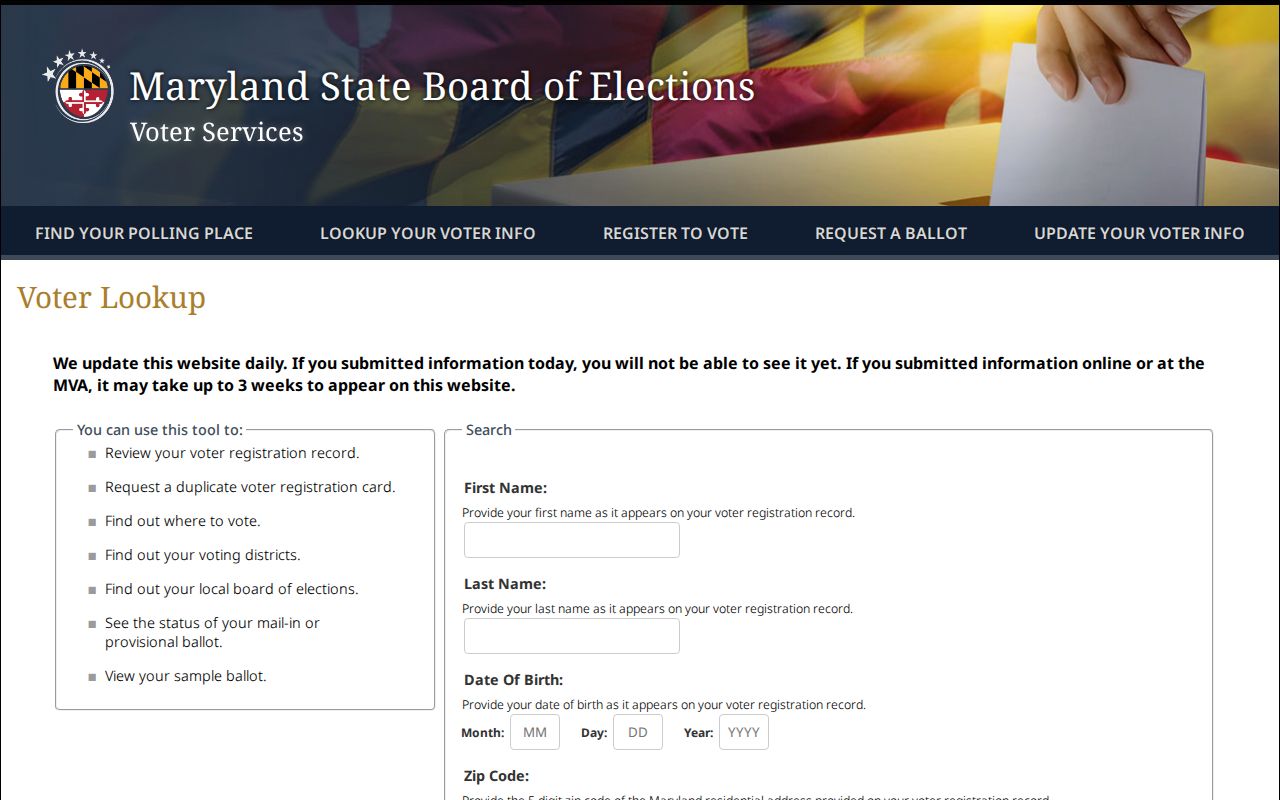
Skip the city label and use the residential ZIP the address itself carries. A Carney lookup depends on that detail. The paid Carney voter-list request runs as a separate route under Election Law §3-505. Its Walking List groups voters by precinct and street. The request form demands a permitted-use declaration. It bars commercial solicitation along with any non-electoral use.
Carney Vital Checks for Residents
Vital records for Carney sit with more than one Maryland custodian. Current birth and death certificates come from the Maryland Department of Health Division of Vital Records. Older county index and certificate material lives at the Maryland State Archives. Marriage licenses and copies for Carney pass through the Baltimore County Circuit Clerk. Divorce files stay with the court that granted them. State law puts a 100-year restriction on birth records. It also sets a 10-year hold on death records under Government §9-1015. Marriage licenses, absolute divorces, and annulments count as unrestricted. Yet Carney copy seekers still face identity checks and payment steps.
Deaths from 2012 forward route through MDH. Archives material, though, shows Baltimore County death records running through 2014. So a Carney death between 2012 and 2014 falls in a gray zone. Confirm the right custodian before mailing any request. The Register of Wills Estate Search helps here too. It returns an estate number, decedent, representative, attorney, status, and dates for Carney estates. That may explain a property transfer, but it does not open address disclosure to strangers.
Carney Resident Affiliation Checks
Maryland Business Express searches a public entity by business name or Department ID. The filing history can corroborate an organization's connection. Maryland Department of Labor runs profession-specific tools. MDH board verification can show a public license status, number, dates, or discipline fields where the board exposes them. These answer business questions, not home locations. The Maryland Labor license-query entry point sorts its public searches by profession rather than presenting one universal personal profile.
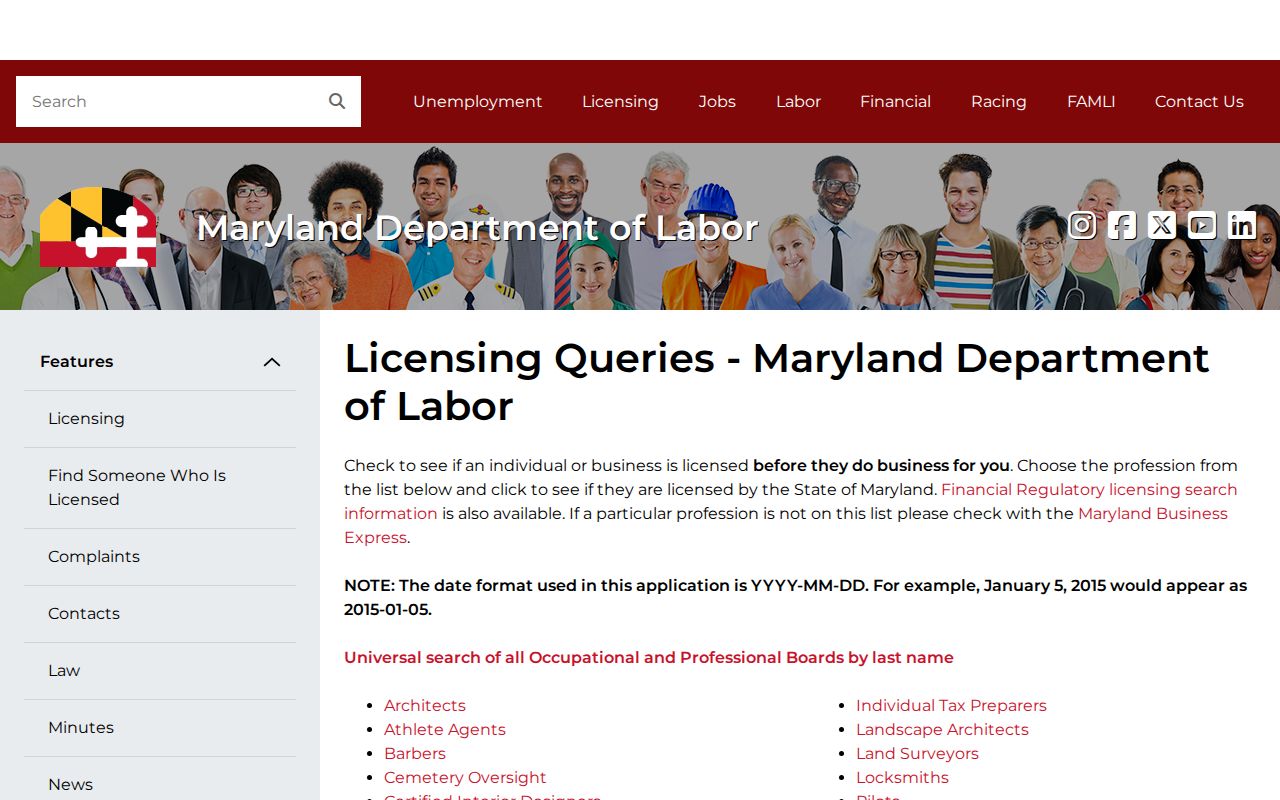
A name alone proves little. Dates and official identifiers do the real work. Match any entity or license result against its public filing date, license type, and record number before trusting a Carney connection. A registered agent, business filing address, or professional entry is never a home address.
Carney Records Include Narrow State Registries
Maryland runs several narrow public registries, each with a stated scope. The Maryland Sex Offender Registry allows a statewide name or area search. A disclaimer and written-copy options are attached. DPSCS supplies the notices, and the registry serves that purpose alone. It is not an identity tool. The DPSCS Inmate Locator covers the Division of Correction, Patuxent, and some short-sentence facilities. It does not cover every county detention or pretrial placement. The Baltimore County Detention Center offers no public roster search. The official registry screen states its statewide scope and notice context before a query begins.
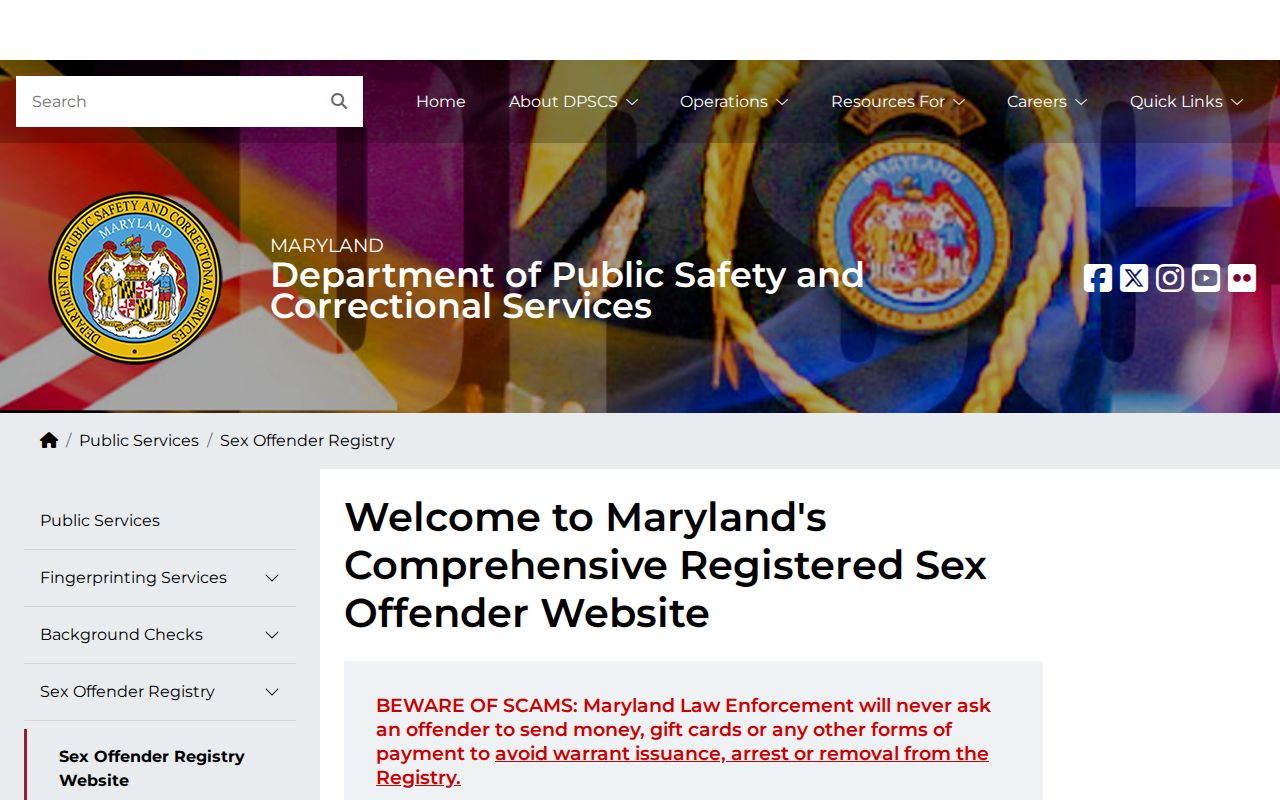
Stop at a same-name dead end. Never fill the gap with an assumption. A correction request, a clerk, or an official contact beats assembling a personal dossier.
Carney Records Need a Targeted Request
The Maryland Public Information Act, General Provisions §§4-101 through 4-601, opens a route to an existing nonexempt record. It never creates a duty to build a new list of people. Vague requests stall. Name the office, record type, address, parcel account number, case number, and date range. Precision matters here. Ask for the segregable public portion when redactions are needed. Written applications are normally required unless the custodian waives them. OAG guidance frames prompt responses within 30 days, with a ten-day estimate whenever completion takes longer than ten days. Baltimore County property files follow their own path. For a permit, code, inspection, or related property file that is not online, the county PAI form asks for the property or facility, street, subdivision, tax map, grid, parcel, lot, tax ID, case number, description, and date range. Its listed public-information contact is 410-887-3353. A court file belongs with the clerk instead. A historical question may fit the Archives or a librarian better. Each route works only when it names a specific record that the office maintains.
Carney Resident Record Privacy
Maryland deliberately keeps some records out of ordinary name searching. Safe at Home shields qualifying victims. It supplies a substitute address and mail forwarding. Protected voters can be nonconfirmable through ordinary online or mail channels. Driver and motor-vehicle records stay private except for the subject or an authorized DPPA requester. Utilities and private delivery records never form public resident rolls. Household membership stays private too. Sealed court files and restricted vital certificates stay closed as well. A blank result can be privacy, not a defect.
Lawful use. Use public records for personal, lawful research and keep the source, date, and record limit visible. Maryland Criminal Law §§3-802 and 3-803 address stalking and harassment; no record may be used to threaten, track, harass, or intimidate anyone.
An old address needs different tools than one verified person. Dated volumes and library routes fit better. The Carney city directory page beats forcing current indexes to answer a historical question.